The Sanctuary That Wanted to Disappear:
6 Surprising Lessons from Big Cat Rescue’s 20-Year Mission
The Impossible Goal: Engineering Your Own Obsolescence
In the high-stakes world of non-profit strategy, success is usually measured by growth: more donors, more staff, and a larger physical footprint. But for a Senior Conservation Strategist, the ultimate metric of success is the "Mission Accomplished" paradox—solving a problem so fundamentally that the organization’s original form is no longer required. For thirty years, Big Cat Rescue navigated the global crisis of captive big cats with a radical endgame in mind: putting itself out of business. This wasn't a retreat; it was a calculated evolution from reactive rescue to systemic victory.
Takeaway 1: The ROI Shift—Success Means Closing Your Doors
In 2006, Big Cat Rescue was a titan of physical rescue, managing a massive footprint with 142 cats and over 100 dedicated volunteers. At the time, the strategic focus was on capacity and oversight. However, leadership recognized an unsustainable trajectory. By 2008, the organization had engineered a sophisticated non-profit model, growing net assets from $148,000 in 1996 to over 2.7 million, while maintaining an 86% program spend.
The strategic epiphany was simple: the organization could save more cats through a $10,000 legislative push than a $10,000 enclosure. This shift in Return on Investment (ROI) led to the ultimate "Mission Accomplished" moment in 2024. As the final residents were relocated to permanent care, the once-bustling sanctuary grounds—formerly filled with the roars of lions—were left to the wild.
"Carole Baskin had always said that she was going to put herself out of business and she did... After decades of conservation efforts and going up against some of the most revolting criminal big cat abusers... she did it. Carole Baskin turned all of the adversities into all she needed to end it." — Heather Pepe-Dillon, WILD Florida Rescue (2024 Annual Report)
Takeaway 2: The Longevity Paradox—Beating "Wild" Life Expectancy
Big Cat Rescue didn't just house cats; they pioneered a geriatric care model that defied biological norms for the species. Data from the 2011, 2014, and 2018 reports show that residents frequently lived into their late teens and 20s, nearly doubling the life expectancy of their wild counterparts.
Record-Breaking Longevity:
• Scratch (Cougar): 29 years
• Sabre (Leopard): 25 years
• Flavio (Tiger): 25 years
• Amazing Grace (Ocelot): 22 years
• Precious (Bobcat): 21 years
• Sasha (Lion): 20 years
This wasn't accidental. The 2011 report details an "operant conditioning program" led by expert volunteers, which allowed for medical treatments with minimal stress. Strategically, Big Cat Rescue had to overcome the "early nutrition paradox"—the reality that most captive-born cubs suffer from permanent bone and dental deficiencies because they were pulled from their mothers for bottle-feeding. By implementing specialized nutrition and low-stress veterinary protocols, BCR transformed from a mere shelter into a laboratory for feline longevity.
Takeaway 3: Winning the Legislative "Long Game"
The transition from a physical sanctuary to an advocacy powerhouse was born from a 2003 turning point. That year, requests for rescues reached 312, a number that had been doubling annually. Carole and Howard Baskin realized that building more cages was a losing game; the only way to win was to shut off the tap of supply.
Big Cat Rescue pivoted its resources to cultivate "AdvoCats," a grassroots army that grew to 54,447 members by 2011. This legislative "Long Game" targeted the root causes: private ownership and cub-petting. The strategy saw its greatest ROI with the Big Cat Public Safety Act. A pivotal federal ban enacted in 2022 that effectively ended the "legal smokescreen" used by breeders and traffickers.
Takeaway 4: Tech-Driven Conservation—From VR to In-Situ Deterrents
As Big Cat Rescue prepared to sunset its physical location, it pivoted to high-impact in-situ (in the wild) technology. The 2020 transition to Virtual Reality (VR) was a strategic masterstroke, replacing "caged displays" with digital education that offered a 360-degree intimate experience without the ethical cost of captivity.
More critically, Big Cat Rescue invested in "peace-keeping" tech for global habitats. This included:
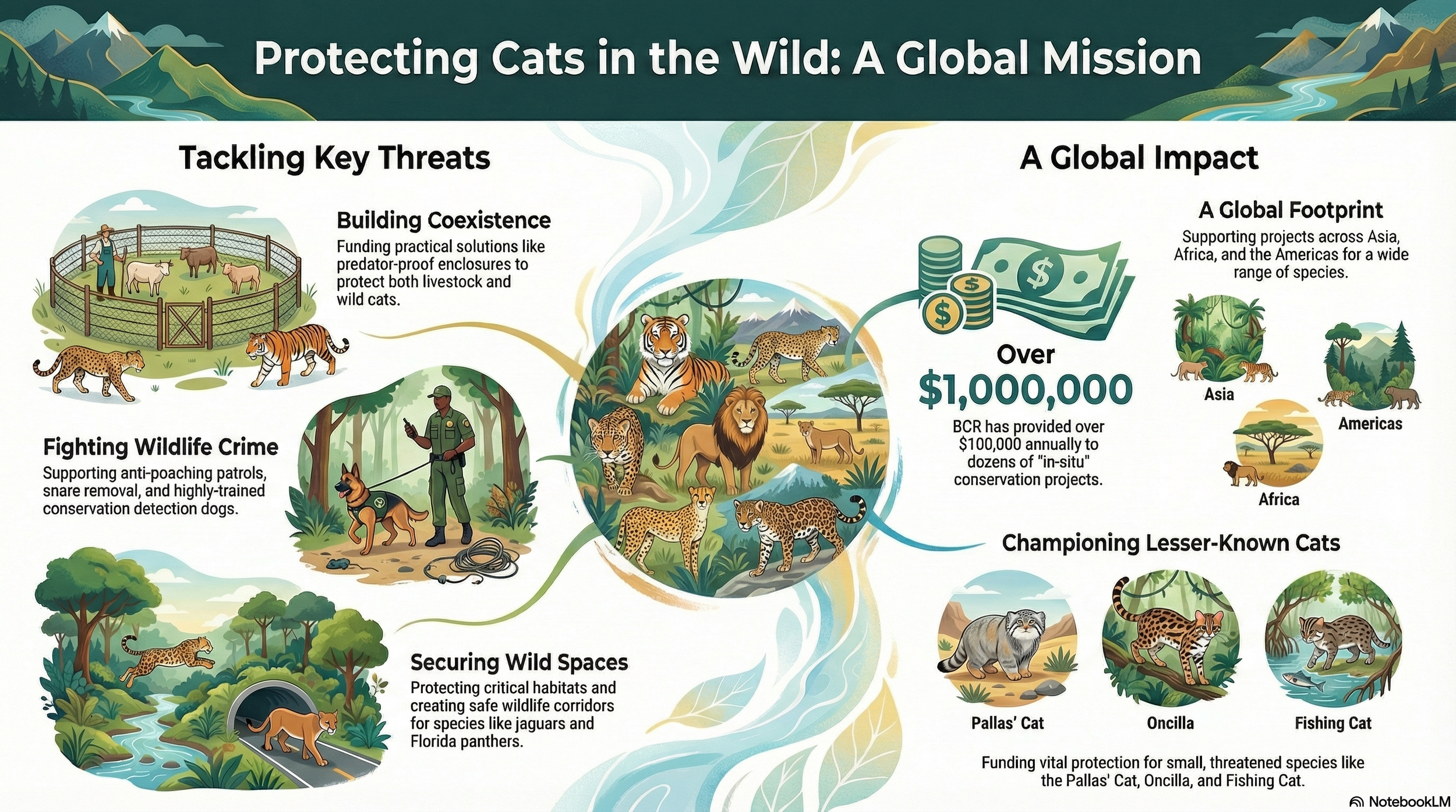
• Blink+A Carnivore Deterrent: A solar-powered AI system in Patagonia that uses light and sound to prevent pumas from approaching livestock.
• Solar Powered Wells: In Ranthambore, India, Big Cat Rescue funded wells to create watering holes for tigers. Strategically, this addresses the root of human-tiger conflict: thirst drives tigers into human settlements, leading to retaliatory killings. By providing water, BCR used tech to create a non-lethal buffer zone.
Takeaway 5: The "Sanctuary-in-a-Box" and Open-Source Leadership
A hallmark of a Senior Strategist is the willingness to raise the "industry floor," even for competitors. Big Cat Rescue committed to "open-sourcing" its operational blueprints, creating 22+ Intranet sites—a "Sanctuary-in-a-Box" resource. For free, Big Cat Rescue offered training videos, animal care charts, and manuals to any non-breeding facility.
This was a calculated move to standardize care. By sharing "operational secrets," Big Cat Rescue ensured that their high standards for animal welfare and volunteer management would persist across the industry long after their own doors closed. It was leadership through transparency, prioritizing the species over organizational ego.
Takeaway 6: Reclaiming the Wild—The Literal End of the Sanctuary
The final phase of the Big Cat Rescue mission was the reclamation of its physical footprint. In a poetic fulfillment of their 30-year promise, the sanctuary grounds were sold to fund the future. Big Cat Rescue closed on the sale of 56 acres in December 2024, followed by the final 11 acres in January 2025.
The proceeds from these 67 acres were strategically redeployed to fund permanent, lifetime care for relocated cats at Turpentine Creek and to bolster global conservation projects indefinitely into the future. Today, the Florida grounds are no longer a place of cages; they were cleared away to fund the very nature they sought to protect.
Conclusion: A Legacy Beyond Fences
The story of Big Cat Rescue is a case study in strategic transcendence. They didn't just close a facility; they engineered a legislative victory that ended the era of private big cat ownership in the U.S., then pivoted their capital to protect the wild. As we look forward, the challenge remains in-situ: can we use the lessons of the last 30+ years to ensure that tigers, pumas, and leopards thrive in their native habitats? The fences are gone, but the mission continues in every watering hole and every digital classroom Big Cat Rescue helped build.
Check out the annual reports below.









https://bigcatrescue.org/conservation-news/2025-annual-report
https://bigcatrescue.org/conservation-news/2024-annual-report
https://bigcatrescue.org/2023-annual-report/
https://bigcatrescue.org/2022-annual-report/
https://bigcatrescue.org/2021-annual-report/
https://bigcatrescue.org/2020-annual-report/
https://bigcatrescue.org/2019-annual-report/
https://bigcatrescue.org/2018-annual-report/
https://bigcatrescue.org/2017-annual-report/
https://bigcatrescue.org/2016-annual-report/
https://bigcatrescue.org/2015-annual-report/
https://bigcatrescue.org/2014-annual-report/
https://bigcatrescue.org/2013-annual-report/
https://bigcatrescue.org/2012-annual-report/
https://bigcatrescue.org/2011-annual-report/
https://bigcatrescue.org/2010-annual-report/
https://bigcatrescue.org/2009-annual-report/
https://bigcatrescue.org/2008-annual-report/
https://bigcatrescue.org/2007-annual-report/
https://bigcatrescue.org/2006-annual-report/
https://bigcatrescue.org/2005-annual-report/
https://bigcatrescue.org/2004-annual-report/
https://bigcatrescue.org/2003-annual-report/
Transparency You Can Trust 👁️
Our Annual Reports are your window into our sanctuary. They cover everything from financial expenditures and incoming donations to the lives we've touched both in our facility and in the wild. The reports showcase our year-over-year growth and the effectiveness of our campaigns, including our push to end the cub petting industry and private ownership of big cats in the U.S. Dive in and discover how your support is making a world of difference for these magnificent creatures.
Donec id justo non metus auctor commodo ut quis enim. Mauris fringilla dolor vel condimentum imperdiet.