Marbled Cat Facts

Marbled Cat: The Forest’s Hidden Masterpiece
The Marbled Cat is one of nature’s most enigmatic small felids. Though it bears a striking physical resemblance to a miniature clouded leopard, genetic research reveals it belongs to a unique and ancient lineage of wild cats. Often described as a "big cat in a small package," this elusive climber is a vital part of Asia’s tropical forest ecosystems.
Quick Facts
Common Name: Marbled Cat
Kingdom: Animalia
Phylum: Chordata (Vertebrata)
Class: Mammalia
Order: Carnivora
Family: Felidae
Genus: Pantherinae (Pardofelis)
Species: marmorata
Scientific Name: Pardofelis marmorata
Status: Near Threatened (IUCN)
Population Trend: Decreasing
Weight: 9 – 18 pounds
Lifespan: Up to 12 years in captivity; unknown in the wild
Misc: Genetic studies of this cats blood serum, shows that it shares an identical karyotype with Lynx, Panthera and Uncia, leaving this cats evolutionary history somewhat of a taxonomic puzzle. Perhaps, this little cat is similar in form to the forest ancestors of the big cats some 10 million years ago (Collier and O’Brien, 1985). However, it may have also diminished in size more recently due to competition with other big cats.
Appearance
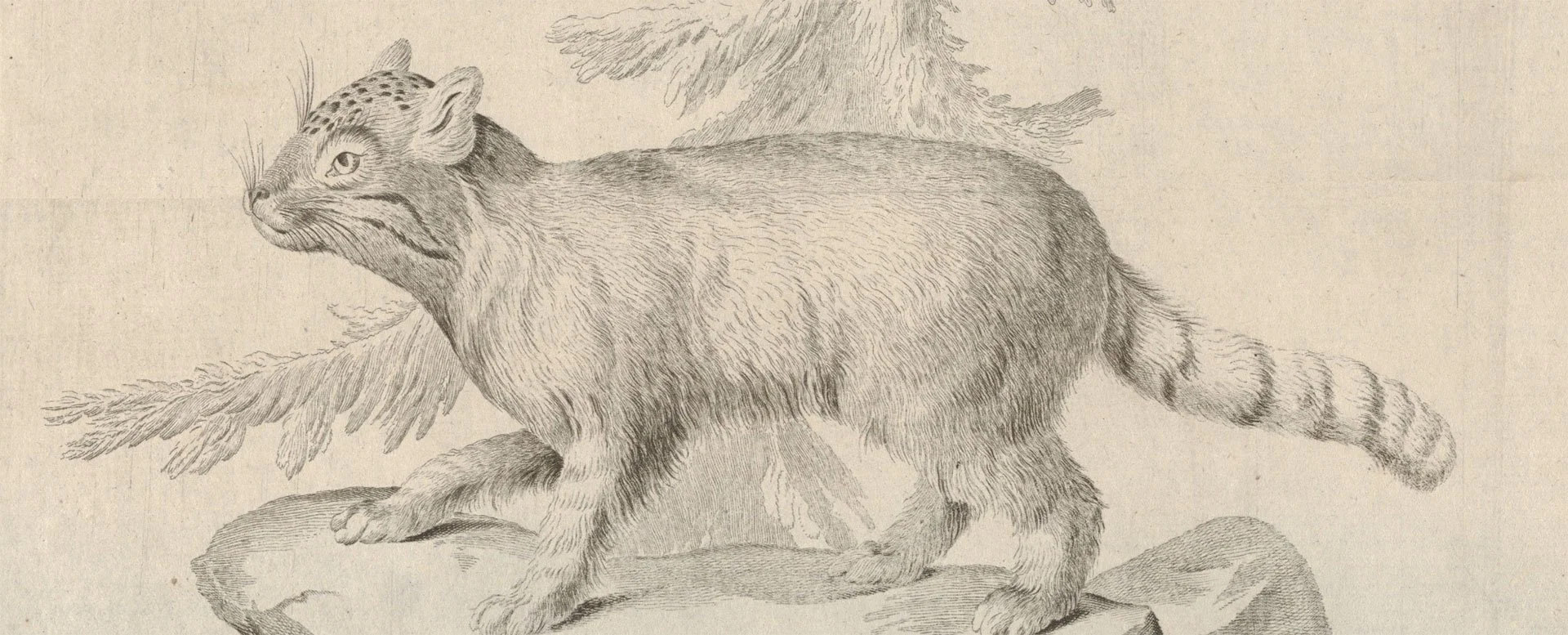
The Marbled Cat is famous for its breathtaking coat, which features thick, soft fur ranging from brownish-gray to reddish-brown. This coat is decorated with large, dark-edged blotches that create a "marbled" effect, complemented by black spots on the legs and distinct stripes on the head and neck.
While it is similar in size to a large domestic cat, its proportions are specialized for life in the trees. It possesses a short, rounded head with a wide forehead and unusually large upper canine teeth. Its most defining feature is its exceptionally long, bushy tail, which serves as a vital counterbalance as the cat navigates the high canopy of the tropical rainforest.
Habitat and Range
The Marbled Cat’s range extends from the Himalayan foothills in Nepal across southwestern China and throughout mainland Southeast Asia to the islands of Borneo and Sumatra. They are primarily found in moist, tropical evergreen forests, but they have also been recorded in mixed deciduous forests and secondary growth areas.
These cats are true forest specialists. While they can persist in degraded or recently logged forests, they appear unable to survive in industrial landscapes like oil palm plantations. They occupy a wide elevational range, from sea level up to 2,500 meters, often favoring rugged, hilly terrain where forest cover remains most intact.
Diet and Behavior
Historically thought to be nocturnal, recent camera-trap data suggest the Marbled Cat is actually primarily diurnal, or active during the day. It is a highly arboreal species, spending a significant portion of its life in the trees, which has led many to call it the Old World equivalent of the Margay.
Its diet is largely composed of tree-dwelling prey, including squirrels, rats, and birds. On the forest floor, it may also hunt reptiles, frogs, and various insects. Despite their small size, they are formidable hunters, utilizing their enlarged canines and agile movements to secure prey in the complex 3D environment of the forest canopy.
Reproduction
Knowledge of Marbled Cat reproduction comes mostly from captive observations. After a gestation period of approximately 81 days, females give birth to a litter of one to four kittens. At birth, these tiny hunters weigh only about 3.5 to 4 ounces. Their development is steady: their ears begin to unfold at five days, their eyes open by the two-week mark, and they typically reach sexual maturity at around 21 months of age.
Threats
The most significant threat to the Marbled Cat is the continued loss and fragmentation of its forest home. Large-scale logging and the expansion of agriculture—particularly the conversion of forests into oil palm plantations—drastically reduce the habitat available to this forest-dependent species.
While they are not as common in wildlife markets as some other cats, they are still victims of the illegal trade for their skin, meat, and bones. Indiscriminate snaring is a major concern throughout Southeast Asia, and Marbled Cats are sometimes killed in retaliation for preying on local poultry. Because their populations are fragmented and their density is naturally low, even small amounts of hunting can have a devastating impact on local groups.
Conservation Efforts
The Marbled Cat is protected under CITES Appendix I, which prohibits international trade, and is legally protected across the majority of its range. National laws in countries such as India, Malaysia, Thailand, and Indonesia strictly forbid hunting these cats.
Active conservation depends on protecting large blocks of intact forest and better understanding the species' biology. Big Cat Rescue has been a proud supporter of these efforts, providing essential funding for field conservation work. This includes supporting vital research and protection initiatives for Marbled Cats in the West Siang region of India. By funding camera-trap surveys and community-based protection, we help ensure that these "miniature clouded leopards" continue to haunt the misty canopies of Asia for generations to come.
See Conservation Work Funded By Big Cat Rescue here:


2023 Saving Marbled Cats
7/19/2023 We just got this update from the field on conservation work to save the Marbled Cat that you helped us fund if you are a donor to Big Cat Rescue. We were able to send $9000.00 in 2022. See more about it at: https://bigcatrescue.org/marbled-cat-conservation/
2022 - 2023 Marbled Cats in West Siang India https://bigcatrescue.org/marbled-cat-conservation/
All conservation insitu work: https://bigcatrescue.org/insitu/
