Wildcat Facts

Quick Facts
Scientific Name: Felis lybica (Afro-Asiatic Wildcat) and Felis silvestris (European Wildcat)
Common Names: Afro-Asiatic Wildcat, African Wildcat, Asiatic Wildcat, European Wildcat, Steppe Cat
Phylum: Chordata (Vertebrata)
Class: Mammalia
Order: Carnivora
Family: Felidae
IUCN Status: Least Concern (Both species)
Gestational Period: Approximately 56 to 63 days
Litter Size: 1 to 5 kittens (3 to 4 is average)
Lifespan: Up to 15 years in captivity
Appearance

While they may resemble a large, robust domestic tabby, wildcats possess distinct physical traits adapted for survival. The European Wildcat (Felis silvestris) is significantly stockier than a house cat, weighing between 7 and 18 pounds. Its thick, gray-brown fur is marked with widely spaced stripes, and it is most easily identified by its bushy, blunt-ended tail marked with dark rings and a black tip.
The Afro-Asiatic Wildcat (Felis lybica) varies in appearance across its massive range. The African populations are typically pale striped tabbies with a coat ranging from sandy to grayish-brown, featuring a distinctive reddish tint on the backs of the ears. In contrast, the Asiatic subspecies (F. l. ornata) is characterized by a pale sand or gray coat covered in small, distinct black spots rather than stripes. Both species often feature a white throat patch and are built for a life of terrestrial hunting.
Habitat and Range

Recent scientific updates have reorganized the taxonomy of these cats, splitting them into two distinct species based on their geographic distribution:
Afro-Asiatic Wildcat (Felis lybica): This species has an expansive range covering nearly all of Africa (except closed tropical rainforests), the Arabian Peninsula, and stretching across Central Asia into India, Mongolia, and Western China. They are highly adaptable, thriving in savannas, scrublands, and even true deserts where mountains provide cover.
European Wildcat (Felis silvestris): Found primarily in the temperate forests of Europe, Anatolia, and the Caucasus. While they were once thought to reside on islands like Sardinia and Corsica, current data shows those populations are actually Afro-Asiatic Wildcats introduced by humans centuries ago.
These cats can be found at elevations ranging from sea level up to 3,000 meters in mountainous regions.
Diet and Behavior
Wildcats are solitary, primarily nocturnal hunters that communicate through scent marking and vocalizations. Their diet is generalist but leans heavily on rodents and lagomorphs (hares and rabbits), which serve as their primary food source across most regions.
They are opportunistic predators and will also consume birds, reptiles, amphibians, insects, and occasionally young antelope or scavenged meat. To avoid larger competitors like the Jungle Cat or Caracal, they often seek refuge in thick vegetation or rocky outcrops. During the day, they rest in hidden dens, such as hollow trees, abandoned burrows from other animals like aardvarks, or dense brush.
Reproduction
Wildcats usually reach sexual maturity at around 11 months of age. Following a two-month gestation, kittens are born blind and begin to walk by their third week. By 12 weeks, the young cats start learning to hunt, and they typically become independent by five months of age. While they are solitary for most of the year, males will compete and call loudly—a behavior known as "caterwauling"—to attract females during the breeding season.
Threats
The most significant threat to the survival of the wildcat is hybridization with domestic cats (Felis catus). Because domestic cats are descendants of the Afro-Asiatic Wildcat, they can easily interbreed. This genetic "pollution" is so widespread that pure wildcats are increasingly rare and may only exist in the most remote areas.
Other major threats include:
Road Mortality: High-speed traffic is a leading cause of death, particularly for males searching for mates.
Habitat Loss: Fragmentation caused by agriculture, commercial development, and industrial expansion (such as gas fields and cotton plantations) reduces suitable living space.
Human Conflict: Wildcats are often killed by farmers in retaliation for preying on poultry or are caught in traps intended for other species.
Disease: Feral domestic cats can transmit dangerous viruses, such as Feline Leukemia (FeLV) and Feline Immunodeficiency Virus (FIV), to wild populations.
Conservation Efforts

Wildcats are currently protected under CITES Appendix II, and many countries have enacted national laws banning the hunting and trading of the species. In regions like Scotland, intensive "Saving Wildcats" projects are underway to manage hybrid populations and reinforce wild numbers through captive breeding.
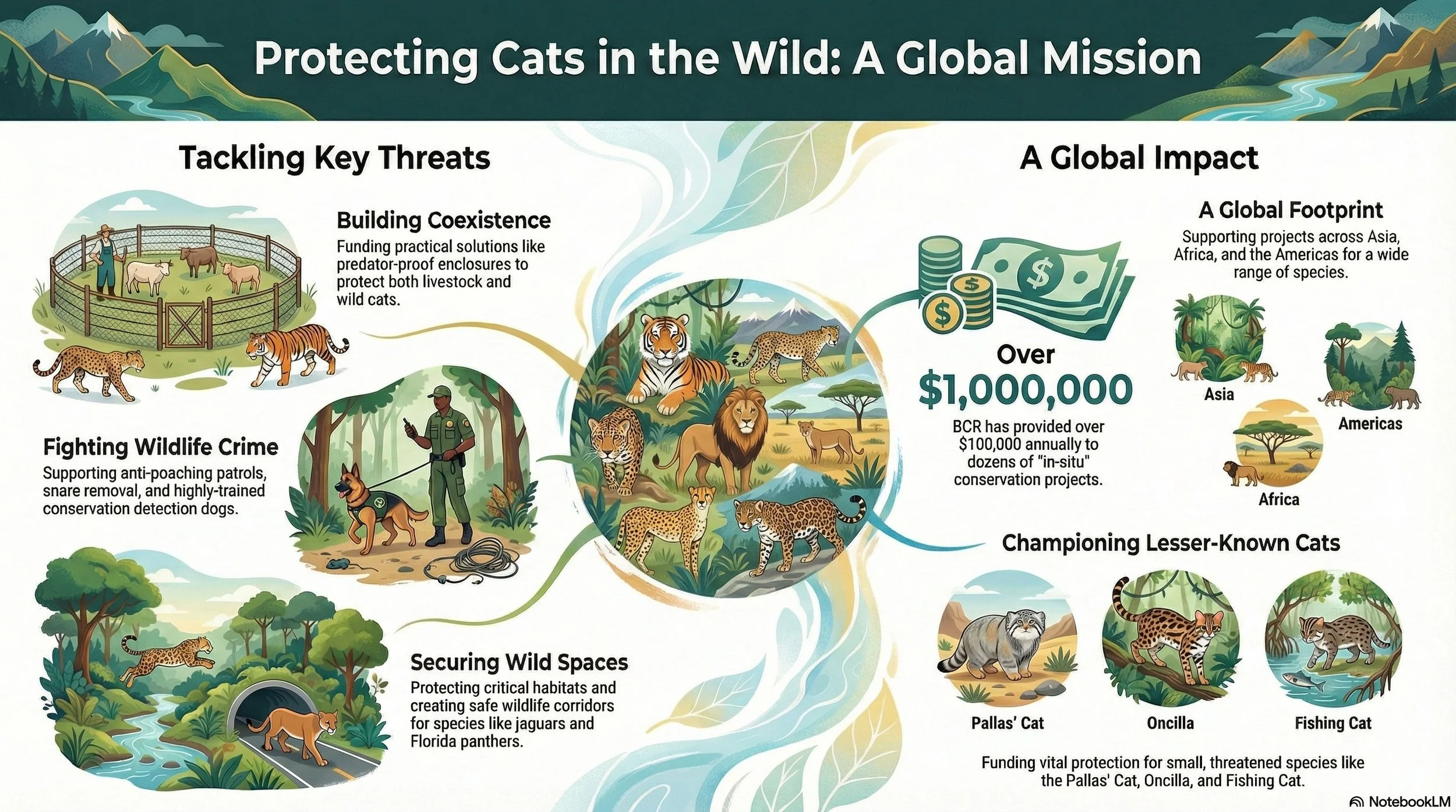
Big Cat Rescue actively supports the protection of these species through its in-situ conservation funding. These contributions help support field research, the mitigation of human-wildlife conflict, and the protection of primary habitats across Africa, Asia, and Europe. By funding these vital projects, Big Cat Rescue works to ensure that pure wildcat lineages are preserved and that these "ancestors of our pets" continue to roam their natural landscapes.
Wildlife Insight: Think of the wildcat as the "blueprinted" version of your pet at home. While your domestic cat is a masterpiece of adaptation to human life, the wildcat is the original, rugged masterpiece of the wilderness—perfected over millennia to survive the harshest deserts and the deepest forests without a helping hand.

European Wildcat by Tadaaki Imaizumi

Scottish Wildcat by Bruce Coleman Ltd
See Conservation Work Funded By Big Cat Rescue here:




All conservation insitu work: https://bigcatrescue.org/insitu/
